When children begin to read and spell one of the first things they have to learn aside from the alphabet and letter sounds, are vowels. Vowels will help support your child’s learning of how words work and to better understand the language they are learning. So today, I’m diving into the question to answer, why are vowels so important?
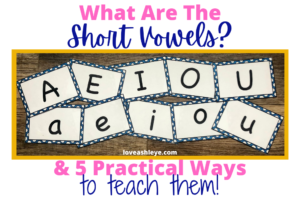
Every word that is in the English language has a vowel of a, e, i, o, or u. Sometimes the letter y is tricky and also acts as a vowel. When children are first taught to read and spell, teachers do not typically start with teaching the letter y as a vowel. There are a lot of words that children will be able to read and spell without knowing that y at times is a vowel.

This post may contain affiliate links, which means I’ll receive a commission if you purchase through my link, at no extra cost to you. Please read my disclosure below.
As children are first exposed to the alphabet at home it may be through the letters of their name or letters they see on a favorite book. However as they go to school and learn more formally their teacher is going to make a point to show them the vowels. So, let’s dig in and learn about vowels.
In the post you’ll learn about why teaching the vowels is important, and when your child is expected to know them.
Why are teaching vowels important?
Teaching vowels are important because they are in and a part of every word that we read and write in the English language. It’s important as children learn to spell that they recognize each word they write must include a vowel. You’ll often see teachers that are working with beginning readers, mark where the vowel belongs.
In first grade, children will begin to learn about compound words. Compound words are two words connected that makeup one word. like trashcan, grapevine, or flashlight.
Then as they continue to learn they are going to be expected to divide words up into syllables. According to the Common Core Standards, first graders are required to:
CCSS.ELA-LITERACY.RF.1.3.D
Use knowledge that every syllable must have a vowel sound to determine the number of syllables in a printed word.
CCSS.ELA-LITERACY.RF.1.3.E
Decode two-syllable words following basic patterns by breaking the words into syllables.
If you want to read more about the Common Core Standards, check them out here. Syllables are broken down by the vowels within the words. As students begin to use and understand vowel patterns they will become stronger readers and spellers.
When children are able to determine if a vowel is using its short sound or long sound, then they can begin to use the rules of the language. This will help support their reading and writing.
When should my child be able to read using different vowel patterns?
Children are usually taught the short vowel sounds first by hearing things like “a-apple-/a/” or “i-igloo-/i/”. They will use these short vowel sounds when spelling (encoding) and reading (decoding) words.
Some of the first words that are taught and mastered are “consonant-vowel-consonant” or CVC words. CVC words are words like bug, nap, pet, mom, and lip. Students will begin to learn and practice with CVC words in Kindergarten. Students are often taught other patterns of words that use the short vowel sound. These words may include words like; fell, bath, and kick.
By the time students reach mid-first grade they are usually beginning to learn the rules of long vowels. Short vowels say the sound of the short name, where long vowels say the name of the letter.
One of the first long vowel patterns that children are taught is silent E. Silent E is the idea that adding e to the end of a word will typically change the vowel from saying the short sound to saying its name. Some examples of these words include take, cube and Pete are all examples of silent E. You will also see these words described as “CVCE” words. This stands for consonant-vowel-consonant-silent E words.
Your child will then be taught, different vowel teams. These are vowels that go together and say the name of one vowel. Most of the time, you’ll hear this described as “when two vowels go walking, the first one does the talking”. This is true for most words but not always. There are exceptions to this rule.
Some examples of these vowel teams are ai, oa, ee, ea, ie, ue, ou, and oi. They will use them in words like rain, toad, keep, pie, blue, out, and foil. These are only some of the vowel teams.
How do I teach vowels to my child?
Many times children will begin to learn and pick up on letters around 2-years-old. You can easily start teaching them the vowels at this time by adding the word to their vocabulary. Children will understand a lot more than they can say especially in the early years.
You can read more about toddler communication skills by reading my post below.

You can easily introduce babies and toddlers to vowels by showing them the letters in their name and saying “Oh look there is a vowel in your name, A is a a vowel!”. This will reinforce their knowledge of letters and vowels within words.
Finally, I’d love to hear from you! Please leave me a comment below letting me know what you have learned about or what questions you have regarding vowels.

Love, Ashley E