To be honest even as a teacher with 13 years of experience, it can get confusing to hear teachers use different acronyms. I have to ask my co-workers if they use something I’m not sure of. As a parent, if there is something a teacher or staff member uses feel free to ask them what they are talking about. Most teachers are happy to explain what they are talking about.

In this post I’m going to explain what CVC words, why they are important for your child’s development, and some activities to teach them. Let’s start with what they are.
In this post you’ll learn what CVC words are, why they are important, and some activities to teach them.
What are CVC words?
The acronym CVC stands for consonant-vowel-consonant. CVC words are basic three-letter words that children learn as they begin to learn how to spell, write, and read words. CVC words are some of the first words taught since they flow easily to be taught right after letter sounds.
After or while children are being taught their letter sounds they can begin to learn that as letters are put together their sounds can create words. These words are easier for children to learn because they only need to use their knowledge of the letter sounds to read and write them.
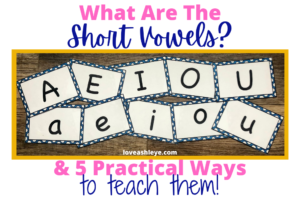
CVC words always have a vowel in the middle of the word, making it easy for new readers and writing to use the words. For more information on vowels, you can check my link below.

When should my child read CVC words?
Children are taught CVC words after they have learned their letters, letter sounds, and have a strong sense of phonemic awareness. CVC words are some of the first words that children learn because they introduce children to the concept that words are made up of letters that make different sounds.
Children need to understand that these words use three distinct sounds that are a beginning, middle (vowel), and end. Consonant-Vowel-Consonant words all use their basic letter sounds that are first taught to children. This includes the vowel which says its short vowel sound. They also need to know that when you put all three of these sounds together it creates a word.
Through phonemic awareness exercises, children will learn that they can manipulate sounds to make and change words. They will also learn that they put together sounds to make a word and that they can put together 2 words to make a new word. You can learn more about phonemic awareness in the post below.

Children will continue to work on CVC words in first grade but they should have a strong sense of reading, writing, and using these words by mid-way through first grade. If you have concerns about your child’s ability to read, write, and spell CVC words make sure you talk to your child’s teacher.
How can I teach CVC words to my child?
A lot of teachers would say there are different ways to teach CVC words. As an intervention specialist, I know that children learn in a variety of different ways. Most children will learn best by doing hands-on activities to learn these skills. T
he first thing you will want to know is if your child knows their letters and sounds. Then you need to make sure they can identify the beginning and ending sounds of words. Next, your child will need to be able to identify their short vowel sounds within words. Finally, they’ll need to be able to read CVC words.
You can use a resource like the one below to see if your child is able to complete these skills:

You will often see these words associated with pictures. Pictures allow children to put these words into context. They learn that these words mean more to them than just words. Instead, they are words that can use and relate to. It is helpful if your child has a strong sense of vocabulary to complete these activities with pictures.
Many teachers will teach CVC words using word families. Word families are words that all end in the same last two letters. For example, cap, map, tap, and lap are all part of the “ap” word family. This is because they all end in the same last two letters. Below is a sample of what you will find in my short I word activities and gives a great example of word families for the short I sound.

Teachers will sometimes teach children all of these “ap” words at the same time to help children focus on learning to change the beginning sounds to make new words.
Now, let’s talk about different CVC word activities you can try with your child.
Activities with CVC Words. . .
Cut & Paste
There are many cut and paste activities for children to practice making CVC words. Below is a sample of example of cut-and-paste activities from Teachers-Pay-Teachers website that shows a way children can cut and paste words to make them.

You can check out my store by following the link here -> https://www.teacherspayteachers.com/Store/Loveashleye
Play-Dough
I love using play-dough to have children create words and these cards are perfect for having them make the words or letters. They are found within my short vowel products on Teachers-Pay-Teachers.

Tap It Out
We teach children to use their fingers to “tap” out words by touch a finger for each letter in the word. CVC words are only 3 letters so they will tap each finger one time each and doing it on three fingers total.
Magnetic Letters
Teachers love having children use magnetic letters to find letters and make words. As a primary teacher, I would use the sensory table with this activity. To do this, I would put the letters into the rice table and the children would find the letters then place them on a metal filing cabinet in the classroom.

Depending on their age or ability I would have them put the letters in alphabetical order or create words with them. I love using the posters in my short vowel packs available for them to make the words after they find the letters.
Rainbow Writing
Rainbow writing is fun because it allows children to practice their spelling using a variety of different colors and writing utensils. They can do it with letters or any word list they are working on.

Check out my store front for a free link to a Rainbow writing page!
Blocks
Using Legos or blocks children are able to build and make words. With this activity being so hands-on children are able to see that sometimes the words they are building will only change one letter to change the words. This is great practice for their word building and helps support phonemic awareness.

Crayon, Marker, Pencil
Children can practice any spelling or sight word using “crayon-marker-pencil”. This activity allows children to practice writing their words three times each using different writing utensils and colors. You simply provide the spelling word they are working on, and the child writes it three times once with a crayon, then with a marker, and finally with a pencil. It’s important that children write the same word 3 times and read it before moving on to the next word.

With any of these activities, it’s best for children to read the words to an adult when they are finished building them. It’s one thing for them to copy or build words but it’s another for them to put their skills into practice and really read them to their teachers or another adult.

I hope this has provided you with a better understanding of what CVC words are, why they are important, and some activities to practice them in your home or classroom.
Love, Ashley E